

Master marble origins for superior design success

Marble has adorned interiors for centuries, yet not all marbles deliver equal durability regardless of fame or origin. Understanding how geological formation and regional provenance shape marble’s performance empowers you to select materials that align perfectly with your design vision, client expectations, and budget realities. This guide reveals the critical differences between marble origins to elevate your specification decisions.
Table of Contents
- Introduction To Marble Origins And Their Importance
- Geological Composition And Characteristics Of Marble Origins
- Visual And Aesthetic Differences By Origin
- Durability And Maintenance Profiles By Origin
- Common Misconceptions About Marble Origins
- Market Availability And Origin Preferences In The U.S.
- Practical Application Of Origin Knowledge In Design Projects
- Enhance Your Projects With Expert Marble Sourcing
Key takeaways
| Point | Details | |-------|---------|| | Geological differences define performance | Calcite purity, mineral inclusions, and metamorphic intensity vary by region, directly impacting hardness, porosity, and longevity. | | Visual traits guide aesthetic choices | Color palettes, veining styles, and translucency differ markedly across origins, enabling targeted design storytelling. | | Maintenance demands vary significantly | Higher porosity marbles from certain regions require more frequent sealing and care compared to denser alternatives. | | Market dynamics shape availability | Italian marbles dominate U.S. imports at premium prices, while Indian and Turkish sources offer budget-friendly performance options. | | Origin knowledge optimizes project outcomes | Matching marble provenance to usage context, aesthetic goals, and maintenance capacity ensures design and financial success. |
Introduction to marble origins and their importance
Marble is metamorphosed limestone composed primarily of calcite crystals, formed through intense heat and pressure over millions of years. The specific geological conditions in each region create distinct mineral compositions, crystal structures, and physical properties that define a marble’s appearance and durability. Understanding these origin-based differences helps you match visual appeal, structural integrity, and maintenance requirements to your project’s unique demands.
Global marble sources like Italy, Greece, Turkey, and India each produce materials with characteristic traits shaped by local geology. Italian marbles such as Carrara and Calacatta are prized for their bright whites and dramatic veining. Greek Thassos delivers exceptional purity and luminosity. Turkish marbles offer blue-green hues and moderate porosity. Indian varieties like Makrana provide dense, hard surfaces ideal for high-traffic applications. Knowing these distinctions enables you to select materials that deliver the right balance of beauty, performance, and cost for every design scenario.
For interior designers and architects working in the U.S. market, origin knowledge directly impacts procurement strategy, client satisfaction, and long-term project success. Different origins present varied availability, pricing structures, and import logistics that influence budget and timeline. A comprehensive marble origin guide clarifies these factors to streamline specification and avoid costly missteps.
Key factors to consider when evaluating marble origins include:
- Geological composition affecting hardness and scratch resistance
- Regional mineral content influencing color stability and staining susceptibility
- Quarry practices and finishing techniques impacting surface quality
- Shipping distances and trade relationships shaping cost and lead times
Geological composition and characteristics of marble origins
Calcite purity, mineral inclusions, and metamorphic conditions vary by region, influencing marble hardness and porosity. Italian Carrara typically contains 95% or higher calcite with minimal impurities, yielding a softer, more translucent stone. Indian Makrana incorporates denser crystal structures due to higher metamorphic temperatures, producing exceptional hardness and abrasion resistance. Turkish marbles often include serpentine and dolomite, adding unique color variations but increasing porosity.
Metamorphic intensity directly affects crystal size and interlocking patterns within the stone. Higher temperatures and pressures create tighter crystal bonds, enhancing strength and reducing vulnerability to cracking. Greek Thassos marble, formed under extreme conditions, exhibits fine-grained crystals that contribute to its bright white appearance and superior polish retention. Conversely, some regional marbles with coarser crystals may show faster wear in high-traffic environments despite attractive aesthetics.
Porosity levels determine how readily marble absorbs liquids, impacting staining risk and maintenance frequency. Lower porosity Italian marbles resist moisture penetration better than higher porosity Turkish varieties. Hardness measured on the Mohs scale ranges from 3 to 5 across different origins, with denser Indian stones approaching the upper end. These physical properties guide appropriate application choices, from delicate decorative accents to robust flooring solutions.
| Origin | Calcite Purity | Crystal Density | Mohs Hardness | Porosity Level |
|---|---|---|---|---|
| Italian Carrara | 95%+ | Medium | 3.0-3.5 | Low-Medium |
| Greek Thassos | 98%+ | High | 3.5-4.0 | Very Low |
| Turkish Blue | 85-90% | Medium-Low | 3.0-3.5 | Medium-High |
| Indian Makrana | 92-95% | Very High | 4.0-4.5 | Low |
Pro Tip: Request porosity test results from suppliers before finalizing marble specifications to verify absorption rates and prevent unexpected sealing costs or maintenance complications that can derail project budgets.
Understanding these geological distinctions allows you to align material selection with project demands documented in your marble selection tips 2025 research. Matching stone characteristics to usage intensity, environmental conditions, and aesthetic priorities ensures design longevity and client satisfaction.
Visual and aesthetic differences by origin
Color palettes vary dramatically across marble origins, shaped by regional mineral content and geological history. Italian Carrara and Statuario present cool whites with gray veining, while Calacatta displays bolder, gold-toned patterns. Greek Thassos offers pure, bright whites with minimal markings, ideal for creating luminous, expansive spaces. Turkish marbles introduce blue-green hues from serpentine inclusions, adding organic warmth. Indian marbles like Makrana range from creamy whites to subtle grays, providing versatile neutrals that complement diverse design styles.
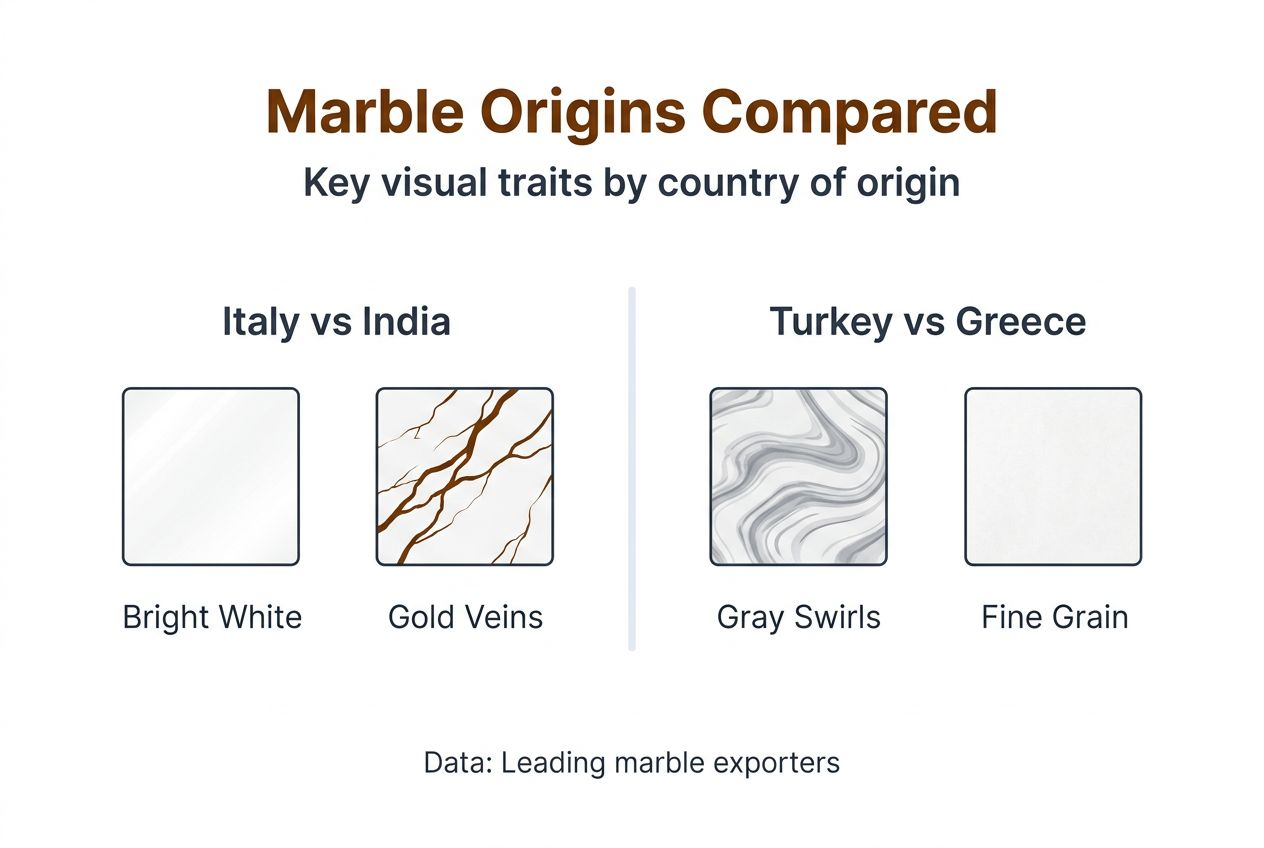
Veining styles tell geographic stories that enhance design narratives and spatial character. Italian marbles often feature linear or branching veins that suggest movement and drama. Greek stones display minimal veining, emphasizing purity and simplicity. Turkish varieties show irregular, cloud-like patterns that evoke natural landscapes. Indian marbles present delicate, fine veining that adds texture without overwhelming visual fields. These distinctive patterns enable you to create specific moods and reinforce project themes through thoughtful material selection detailed in your marble color choices planning.
Translucency profoundly impacts how marble interacts with light, transforming spatial perception and ambiance. Carrara marble’s translucency enhances natural lighting effects in interiors, contributing to enduring design popularity. Backlit applications showcase this property beautifully, creating glowing feature walls or luminous countertops. Denser Indian marbles exhibit less translucency but offer superior durability for high-use surfaces. Greek Thassos balances both qualities, providing moderate light transmission alongside excellent wear resistance.
Carrara marble’s translucency enhances natural lighting effects in interiors, contributing to enduring design popularity and making it a preferred choice for statement installations.
Key visual characteristics to evaluate by origin:
- Italian: Bright whites, dramatic gray or gold veining, moderate translucency, classic elegance
- Greek: Pure whites, minimal veining, fine grain, high luminosity
- Turkish: Blue-green tones, irregular patterns, warm undertones, organic feel
- Indian: Creamy whites, delicate veining, dense appearance, versatile neutrality
Understanding marble veining patterns helps you communicate design intent to clients and coordinate materials across architectural elements. Consistent origin selection ensures visual cohesion while strategic mixing creates intentional contrast and focal points.
Durability and maintenance profiles by origin
Abrasion resistance varies significantly by marble origin, determining suitability for different usage contexts. Indian Makrana’s high crystal density delivers exceptional scratch resistance ideal for commercial lobbies, retail floors, and high-traffic residential areas. Italian Carrara, while visually stunning, requires protective treatments in heavy-use applications to prevent surface dulling. Greek Thassos offers balanced durability suitable for both decorative accents and moderate-traffic spaces. Turkish marbles work well in residential bathrooms and feature walls but need careful consideration for kitchen countertops.

Porosity directly influences staining susceptibility and sealing frequency, impacting long-term maintenance costs. Higher porosity Turkish marbles absorb liquids more readily, requiring sealing every six to twelve months in kitchen or bathroom applications. Lower porosity Italian and Greek varieties extend sealing intervals to 12 to 24 months. Indian marbles’ dense structure minimizes absorption, reducing maintenance demands and lifecycle costs. Understanding these differences prevents client dissatisfaction and costly post-installation remediation.
| Origin | Abrasion Resistance | Staining Risk | Sealing Frequency | Best Applications |
|---|---|---|---|---|
| Italian Carrara | Medium | Medium | 12-18 months | Bathrooms, Feature Walls, Low-Traffic Floors |
| Greek Thassos | Medium-High | Low | 12-24 months | Countertops, Showers, Accent Walls |
| Turkish Blue | Medium-Low | High | 6-12 months | Residential Bathrooms, Decorative Elements |
| Indian Makrana | Very High | Low | 18-36 months | Commercial Floors, High-Traffic Areas, Countertops |
Maintenance best practices tailored to specific marble origins:
- Clean Italian marbles with pH-neutral cleaners to preserve translucency and prevent etching
- Apply penetrating sealers to Turkish varieties before grouting to block staining pathways
- Use microfiber mops on Indian marble floors to maintain polish without scratching
- Avoid acidic substances on all marble types, but especially porous Turkish and softer Italian stones
Pro Tip: Always match marble origin selection to the usage environment and maintenance capacity of your client, prioritizing denser, less porous options for spaces with high staining risk or limited upkeep resources to ensure lasting beauty.
Incorporating origin-specific durability considerations into your marble kitchen design guide specifications protects both aesthetic vision and functional performance throughout the project lifecycle.
Common misconceptions about marble origins
Myth: Darker marbles are always more durable than lighter varieties. Reality reveals that color has no direct correlation with hardness or wear resistance. Durability stems from crystal density and mineral composition, not pigmentation. Light-colored Indian Makrana outperforms many darker marbles in abrasion tests due to its tight crystalline structure. Dark Turkish marbles may appear robust but often exhibit higher porosity than pale Italian Carrara. Evaluate geological properties rather than visual assumptions when assessing performance.
Another common misconception assumes all Italian marble delivers uniform quality and performance. Italy produces diverse varieties from multiple quarries with vastly different characteristics. Carrara from one quarry may differ substantially from another in the same region due to localized geological variations. Calacatta commands premium pricing partly due to rarity and dramatic veining, not necessarily superior durability. Specify exact quarry and grade rather than relying on country of origin alone to ensure consistent material performance.
Price perception often misleads designers into believing cost directly reflects quality or durability. While Italian marbles typically command higher prices due to brand prestige and import logistics, Indian and Turkish alternatives frequently offer comparable or superior performance at lower costs. Market dynamics, scarcity, and fashion trends influence pricing as much as intrinsic material properties. Budget-conscious projects can achieve exceptional results by prioritizing geological suitability over origin reputation.
Top misconceptions about marble origins debunked:
- All marbles from prestigious regions automatically suit any application, when usage context must drive selection regardless of origin fame.
- Imported European marbles always outlast domestic or Asian alternatives, though Indian stones often exceed European durability in high-traffic settings.
- Higher price guarantees better performance, while cost primarily reflects market demand, rarity, and shipping rather than functional superiority.
- Marble origin alone determines appearance consistency, but quarry location, block selection, and finishing practices create variation within single origins.
Recognizing these myths prevents specification errors that compromise project outcomes. Detailed knowledge of actual geological properties and performance data trumps generalized origin assumptions. Resources like marble interior impact analyses help separate marketing narratives from material realities, enabling evidence-based decisions.
Market availability and origin preferences in the U.S.
Italian marble contributes approximately 45% of natural stone imports to the U.S., driven by sustained demand for Carrara, Calacatta, and Statuario varieties among luxury residential and hospitality projects. This market dominance reflects both genuine material appeal and strong brand recognition that commands premium pricing. Greek Thassos holds a smaller but stable share, favored for its purity in high-end bathroom and spa installations. Turkish and Indian marbles collectively represent growing segments as designers discover their performance advantages and cost efficiencies.
Cost trends reveal significant pricing disparities tied to origin perception and import logistics. Italian marbles range from $15 to $100+ per square foot depending on rarity and finishing, with Calacatta Gold reaching the upper spectrum. Greek Thassos typically falls between $25 and $60 per square foot. Turkish varieties offer budget-friendly options at $8 to $30 per square foot. Indian marbles present exceptional value at $10 to $40 per square foot while delivering durability that rivals or exceeds premium European alternatives.
| Origin | Import Volume Share | Price Range ($/sq ft) | Popular Applications |
|---|---|---|---|
| Italian | ~45% | $15-$100+ | Luxury Residential, Hospitality, Feature Walls |
| Greek | ~15% | $25-$60 | High-End Bathrooms, Spas, Accent Elements |
| Turkish | ~20% | $8-$30 | Residential Bathrooms, Budget Projects, Decorative Uses |
| Indian | ~20% | $10-$40 | Commercial Floors, High-Traffic Areas, Cost-Conscious Luxury |
Market drivers shaping marble origin preferences:
- Designer familiarity and historical use patterns favor established Italian and Greek sources
- Social media and design publications amplify demand for visually distinctive Calacatta and dramatic veining
- Budget constraints push commercial and multifamily projects toward Indian and Turkish alternatives
- Sustainability concerns increasingly highlight shorter shipping distances for domestic or closer sources
Understanding these market dynamics helps you navigate client expectations while optimizing value delivery. Presenting data on performance versus cost opens conversations about best marble types for kitchens that balance aesthetic aspirations with financial realities. Educating clients on lesser-known origins expands design possibilities and demonstrates your expertise in material specification.
Practical application of origin knowledge in design projects
Matching marble origin to design priorities requires systematic evaluation of aesthetic goals, functional demands, and budget parameters. Begin by identifying which factors matter most: visual impact, durability, maintenance tolerance, or cost efficiency. High-profile hospitality lobbies might prioritize dramatic Italian Calacatta despite higher costs and maintenance needs. Commercial office floors demand Indian Makrana’s abrasion resistance over visual showmanship. Residential bathrooms can balance both with Greek Thassos or budget-conscious Turkish alternatives.
Four-step evaluation process for origin-based marble selection:
- Define project priorities by ranking aesthetic impact, durability requirements, maintenance capacity, and budget constraints from most to least critical.
- Research candidate origins using geological data, visual samples, and performance specifications to shortlist materials meeting top priorities.
- Compare lifecycle costs including purchase price, installation complexity, sealing frequency, and cleaning demands to identify true value propositions.
- Verify authentic origin certifications and quarry documentation to ensure material quality matches specifications and client expectations.
Case study: A luxury residential remodel specified Italian Calacatta Gold for a master bathroom vanity, prioritizing dramatic veining and brand prestige despite 20% higher costs than Greek Thassos. The design team accepted increased sealing frequency as worthwhile for achieving the client’s vision. Conversely, a corporate headquarters lobby selected Indian Makrana for 5,000 square feet of flooring, valuing superior abrasion resistance and lower maintenance over visual drama. The project saved 40% on material costs while exceeding durability requirements.
Pro Tip: Always verify authentic origin certifications and request quarry-specific documentation from suppliers to confirm material provenance, ensuring you deliver promised quality and maintain client trust throughout project execution.
Integrating origin knowledge into your specification process enhances decision confidence and client communication. Reference frameworks from marble selection tips 2025 to create systematic evaluation protocols that optimize every material choice. This disciplined approach transforms origin understanding into tangible design and financial success.
Enhance your projects with expert marble sourcing
Selecting the right marble origin transforms design vision into lasting reality, but navigating global sources and quality variations can challenge even experienced professionals. Surfaces Galore offers curated collections sourced directly from premier quarries worldwide, combining authentic Italian elegance, Greek purity, Turkish warmth, and Indian durability. Our expertise helps you match origin characteristics to project requirements, ensuring optimal performance and aesthetic impact.
Explore our extensive marble collections featuring detailed origin information, geological specifications, and application guidance for every design scenario. Our team provides personalized support to streamline specification, optimize budgets, and coordinate logistics from quarry to installation. Whether you’re sourcing statement Calacatta for a luxury residence or durable Makrana for commercial spaces, we deliver quality natural stone that elevates your projects and satisfies your clients.
FAQ
What are the main geological differences between Italian and Indian marble?
Italian marble typically has higher calcite purity but lower crystal density compared to Indian varieties. Indian marble like Makrana is denser and harder due to more intense metamorphic conditions. These differences influence texture, polish retention, and suitability for high-traffic spaces.
How does marble origin affect maintenance requirements?
Marbles from higher porosity origins, such as Turkish sources, require more frequent sealing every 6 to 12 months to prevent staining. Lower porosity marbles like Italian Carrara and Indian Makrana need less intensive maintenance, with sealing intervals extending to 12 to 36 months depending on usage.
Are all marbles from Italy equally reliable for interior design?
No, marbles vary widely within Italy by region and quarry with different hardness, porosity, and veining characteristics. Carrara differs substantially from Calacatta in both appearance and durability. Designers should specify exact quarry location and grade to ensure consistent material reliability and performance.
Which marble origins are best suited for high-traffic commercial interiors?
Indian Makrana marble is favored for its higher crystal density and superior abrasion resistance in demanding commercial applications. Some European marbles may require additional protective treatments or are better reserved for lower-traffic areas to maintain appearance and structural integrity over time.
Leave a comment