

What Is Marble Filler and Its Role in Tilework

Finding the perfect marble filler for high-end residential projects can be more challenging than sourcing the stone itself. For Southern California interior designers and tile contractors, the right solution must blend seamlessly with natural marble while remaining affordable for clients. Genuine marble fillers are designed to match the original stone’s mineral makeup, resulting in smooth surfaces and invisible repairs. This overview clarifies common misconceptions, compares filler types, and outlines best practices for timeless, professional results.
Table of Contents
- Marble Filler Defined And Common Misconceptions
- Types Of Marble Filler And Key Differences
- Essential Properties And How Marble Fillers Work
- Best Practices For Installation And Longevity
- Risks, Costs, And Common Mistakes To Avoid
Key Takeaways
| Point | Details |
|---|---|
| Understanding Marble Fillers | Genuine marble fillers are specialized materials that match the original stone’s composition and are distinct from generic adhesives or putties. |
| Types of Fillers | There are various types of marble fillers, including calcite-based, dolomite-based, synthetic composite, and hybrid mineral fillers, each suited for specific applications. |
| Installation Best Practices | Proper surface preparation, moisture control, and following mixing instructions are crucial for ensuring the durability and aesthetic performance of marble repairs. |
| Avoiding Common Mistakes | Failing to prepare the surface adequately or using incompatible fillers can lead to costly repairs; proper techniques and professional consultation are essential. |
Marble Filler Defined and Common Misconceptions
Marble filler represents a specialized material used in stone restoration and tilework to repair imperfections and create seamless surfaces. Often misunderstood, these fillers are critical for achieving professional-grade marble installations with smooth, uniform appearances. Marble fillers derive from complex mineral compositions) that match the original stone’s crystalline structure.
Understanding marble fillers requires distinguishing between authentic stone-based products and synthetic alternatives. Key characteristics include:
- Composition matching original marble minerals
- Ability to repair surface irregularities
- Color and texture consistency with existing stonework
- Non-destructive application techniques
Professional contractors recognize that marble fillers are not simple putties or generic sealants. Genuine marble fillers are engineered materials designed to integrate seamlessly with natural stone substrates. Metamorphic rock characteristics/08%3A_Metamorphic_Minerals_and_Metamorphic_Rocks/8.06%3A_Metasedimentary_Rocks/8.6.03%3A_Metamorphosed_Limestones_and_Dolostones_(Marbles)) play a crucial role in determining appropriate filler selection and application.
Common misconceptions about marble fillers often stem from limited understanding of their specialized nature. Homeowners and inexperienced contractors might mistakenly believe any adhesive or epoxy can effectively repair marble surfaces. In reality, successful marble filler application requires precise material matching, expert technique, and deep knowledge of stone properties.
Pro tip: Always consult a professional stone restoration specialist to ensure your marble filler matches the specific mineral composition and aesthetic requirements of your unique stone surface.
Types of Marble Filler and Key Differences
Marble fillers represent a diverse range of specialized materials designed to restore and enhance natural stone surfaces. Marble filler compositions vary significantly depending on the specific restoration requirements and underlying stone characteristics. These materials are engineered to match the unique mineral properties of different marble types, ensuring seamless repairs and consistent aesthetic appearance.
The primary types of marble fillers can be categorized based on their composition and intended application:
- Calcite-based fillers: Ideal for traditional white and light-colored marble surfaces
- Dolomite-based fillers: Best suited for darker or more complex marble varieties
- Synthetic composite fillers: Engineered to mimic specific marble characteristics
- Hybrid mineral fillers: Combining natural and synthetic components for enhanced performance
Professional-grade marble fillers require precise material selection based on several critical factors. Marble flooring specifications demand careful filler matching to accommodate variations in porosity, hardness, and environmental exposure. Contractors must consider factors such as chemical resistance, color consistency, and long-term durability when choosing the appropriate filler for a specific marble surface.

Understanding the nuanced differences between marble filler types is crucial for achieving professional-quality results. While some fillers are designed for minor surface repairs, others are engineered for comprehensive restoration projects. The selection process involves evaluating the marble’s mineral composition, intended use, and potential stress factors to ensure optimal performance and aesthetic integration.
Here’s a side-by-side comparison of marble filler types and where each excels:
| Filler Type | Typical Marble Match | Durability Level | Best Application Scenario |
|---|---|---|---|
| Calcite-based | Classic white/light marble | Moderate | Minor surface repairs |
| Dolomite-based | Dark or complex colored marble | High | High-wear locations |
| Synthetic composite | Any, when color match is critical | Varies by formula | Custom or decorative repairs |
| Hybrid mineral | Challenging stone blends | Highest | Large-scale restoration projects |
Pro tip: Always conduct a small test application in an inconspicuous area to verify the filler’s color match and performance before completing a full marble restoration project.
Essential Properties and How Marble Fillers Work
Marble fillers are sophisticated materials engineered to restore and enhance natural stone surfaces with precision and durability. Filler properties critically influence material performance by modifying physical structures and improving surface integrity. These specialized compounds work at a microscopic level to repair imperfections while maintaining the marble’s inherent aesthetic qualities.
Key essential properties of high-performance marble fillers include:
- Particle size: Ultra-fine particles for seamless integration
- Chemical compatibility: Matching marble’s mineral composition
- Adhesion strength: Ensuring long-lasting bonding with stone substrate
- Thermal stability: Resistance to temperature fluctuations
- Color matching: Preserving visual consistency with original stone
Mechanical interactions play a crucial role in marble filler effectiveness. Filler geometry determines material performance through characteristics like particle shape, angularity, and surface texture. Professionals must carefully select fillers that can seamlessly bond with marble’s crystalline structure, filling microscopic fractures and voids without compromising the stone’s natural appearance.
The application process requires meticulous preparation and technique. Marble fillers work by penetrating surface irregularities, creating a uniform layer that restores structural integrity and visual smoothness. Advanced formulations can accommodate different marble types, from soft white varieties to dense, darker stone surfaces, making them versatile solutions for restoration and repair projects.
Pro tip: Always test marble fillers on a small, inconspicuous area first to verify color match and performance characteristics before completing a full restoration.
Best Practices for Installation and Longevity
Successful marble filler installation requires meticulous attention to detail and adherence to professional standards. Tile installation guidelines emphasize precise substrate preparation as the foundation for long-lasting marble repairs. Contractors and homeowners must understand that the quality of preparation directly influences the durability and aesthetic performance of marble fillers.
Key best practices for marble filler installation include:
- Surface preparation: Complete removal of loose debris and contaminants
- Moisture control: Ensuring substrate is completely dry before application
- Temperature considerations: Working within recommended environmental conditions
- Precise mixing: Following manufacturer’s instructions for filler composition
- Systematic application: Using consistent techniques for even coverage
Professional application techniques are critical for achieving optimal results. The installation process demands careful selection of tools, precise mixing ratios, and methodical application strategies. Professionals must evaluate the specific marble type, surface condition, and environmental factors to determine the most appropriate filler and application method.
Long-term performance depends on several crucial factors beyond initial installation. Proper sealing, regular maintenance, and understanding the marble’s inherent characteristics can significantly extend the lifespan of marble filler repairs. Contractors should educate clients about appropriate care techniques, including cleaning methods, periodic resealing, and avoiding harsh chemical treatments that could compromise the filler’s integrity.
The following table summarizes essential steps and their impact on marble filler repair longevity:
| Installation Step | Why It Matters | Result of Skipping It |
|---|---|---|
| Surface preparation | Ensures strong filler bonding | Early debonding or failure |
| Moisture control | Prevents filler swelling or cracks | Warping and weak repair points |
| Correct mixing | Achieves chemical stability | Color inconsistency, weak fill |
| Proper curing time | Maximizes filler hardness | Soft, easily damaged repairs |
Pro tip: Allow marble fillers to cure completely before exposing the surface to heavy traffic or moisture, and always use pH-neutral cleaning products to maintain the repair’s longevity.
Risks, Costs, and Common Mistakes to Avoid
Marble filler application risks can quickly escalate repair costs when professionals and homeowners fail to follow critical preparation and installation protocols. Understanding potential pitfalls is essential for maintaining the integrity and aesthetic value of marble surfaces, preventing expensive and time-consuming restoration work.
Common mistakes in marble filler application include:
- Inadequate surface preparation: Failing to clean and prime the surface thoroughly
- Incompatible filler selection: Using materials mismatched to marble’s mineral composition
- Improper mixing ratios: Neglecting manufacturer’s precise instructions
- Rushed application techniques: Applying fillers without proper environmental controls
- Insufficient curing time: Exposing repairs to stress before complete hardening
Cost implications can be substantial when marble filler repairs are executed incorrectly. Repair failures often result from diagnostic oversights that prevent addressing underlying structural issues. Professional contractors must conduct comprehensive assessments to identify root causes of marble damage, ensuring that fillers provide not just cosmetic correction but long-term structural integrity.
Risks extend beyond immediate repair quality, potentially compromising the entire marble installation’s value and performance. Inexperienced practitioners might inadvertently create more extensive damage through improper techniques, leading to complete surface replacement—a significantly more expensive outcome than careful, methodical filler application.
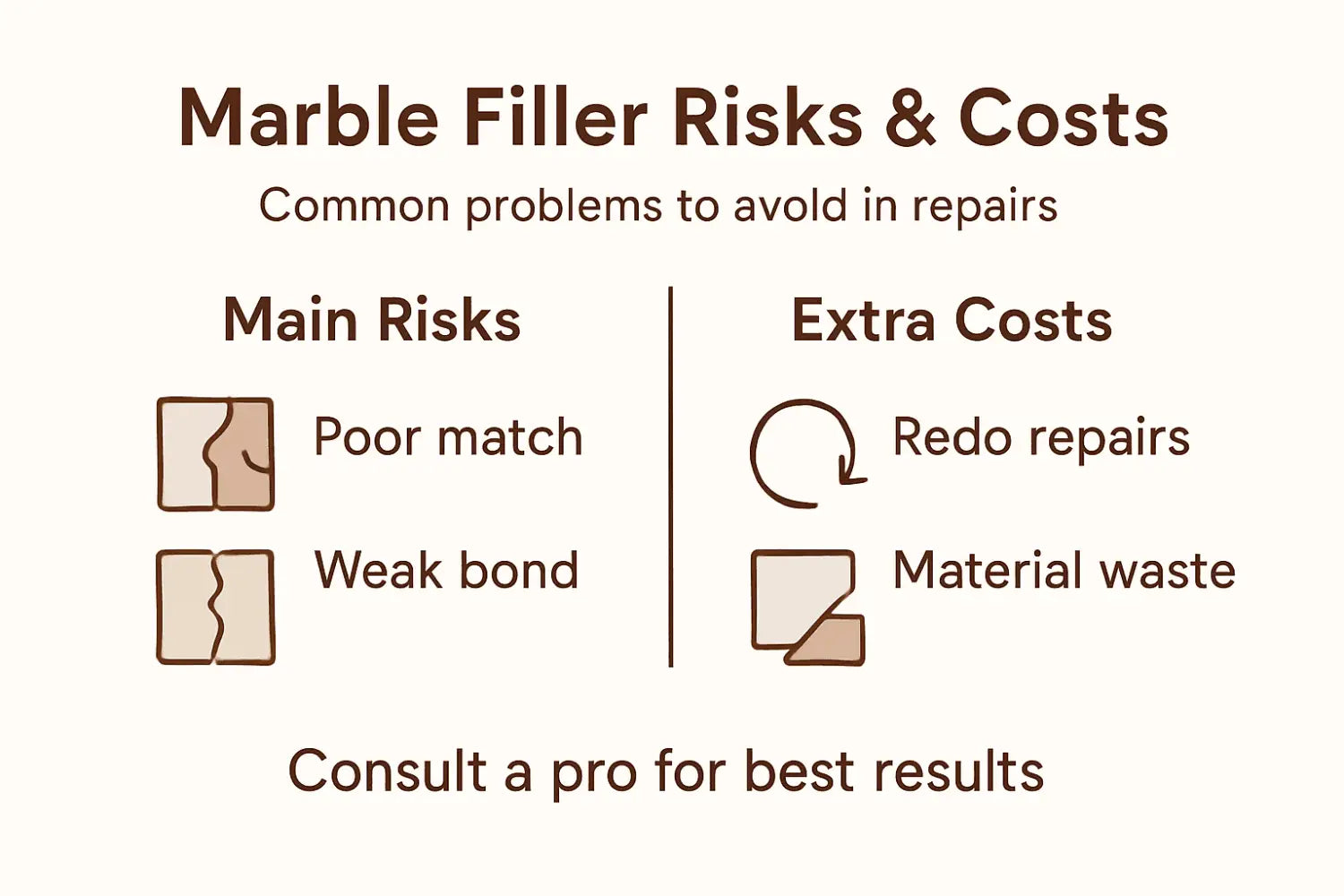
Pro tip: Invest in professional consultation and high-quality materials upfront to avoid exponentially higher restoration costs caused by repeated unsuccessful repair attempts.
Restore Your Marble Surfaces with Confidence Using Premium Natural Stone from Surfaces Galore
Marble fillers are essential for flawless tilework but finding the right materials that match your marble’s unique mineral composition can be challenging. Whether you are a homeowner or contractor concerned about color consistency, durability, or achieving professional-grade repairs, having access to authentic, high-quality marble is critical. At Surfaces Galore, we understand the importance of matching your marble filler to genuine stone substrates for seamless restoration results.

Explore our extensive collection of natural marble and travertine tiles designed to beautifully complement your restoration projects. We provide durable, elegant stone shipped nationwide with the reliability your project deserves. Ready to enhance your marble surfaces with materials that deliver lasting beauty and structural integrity Visit Surfaces Galore today to discover premium products that align perfectly with your professional standards and aesthetic goals. Don’t wait to access the quality natural stone that ensures your marble filler work stands the test of time.
Frequently Asked Questions
What is marble filler?
Marble filler is a specialized material used in stone restoration and tilework to repair imperfections and create seamless surfaces on marble installations. It is designed to match the original stone’s mineral composition and ensure a professional-grade appearance.
How do I choose the right type of marble filler for my project?
When selecting a marble filler, consider the composition of your marble—such as calcite-based for lighter stones or dolomite-based for darker varieties. Additionally, assess the filler’s durability, compatibility with the marble, and the specific requirements of your repair project.
What are the common mistakes to avoid when using marble fillers?
Common mistakes include inadequate surface preparation, using incompatible fillers, neglecting proper mixing ratios, applying under inappropriate environmental conditions, and not allowing sufficient curing time for the filler.
How can I ensure the longevity of marble filler repairs?
To maximize the longevity of marble filler repairs, adhere to proper surface preparation, control moisture, mix fillers according to the manufacturer’s instructions, and allow adequate curing time before exposing the surface to stress or moisture.
Leave a comment