
Bookmatched marble: transform your space with artful stone

TL;DR:
- Bookmatched marble uses sequential slabs from the same stone block to create symmetrical, mirror-image veining patterns that elevate high-visibility surfaces. The process involves precise digital layout, strict seam control, and expert installation, which significantly increases costs compared to standard marble. It is most beneficial in large, prominent areas with bold veining, providing a dramatic, gallery-quality focal point that enhances the space’s luxury and value.
Most homeowners assume all marble looks similar once it’s installed. You pick a slab, a fabricator cuts it, and the stone goes on your wall or countertop. That’s marble, right? Not quite. There’s a technique that turns natural stone into something that looks less like a surface and more like a painting. Bookmatched marble uses sequential slabs to create perfectly mirrored veining patterns, and the result can completely change how a room feels. This article covers exactly what bookmatched marble is, how it’s made, what it costs, and where to use it so you can make the right call for your renovation.
Table of Contents
- What is bookmatched marble?
- How is bookmatched marble created?
- Costs and value: should you invest in bookmatched marble?
- Design applications: where bookmatched marble makes the biggest impact
- The truth most designers won’t tell you about bookmatched marble
- Ready to explore bookmatched marble for your space?
- Frequently asked questions
Key Takeaways
| Point | Details |
|---|---|
| Bookmatched marble defined | This technique uses sequential slabs flipped to create mirror-image veining across seams. |
| Requires expert planning | Proper bookmatching needs professional layout, precise seam placement, and high-quality slabs. |
| Premium price tag | Expect costs to run 20-40% above standard marble due to complex fabrication and lower yield. |
| High impact in key areas | Bookmatching makes the strongest design statement on feature walls, showers, and countertops. |
| Not always the best fit | Bold-veined marbles justify the investment, but subtle stones may not show a strong bookmatched effect. |
What is bookmatched marble?
Not all marble installations are created equal. When you walk into a high-end hotel lobby or a luxury kitchen and notice that the stone seems to flow in a perfect, almost surreal symmetry, you’re almost certainly looking at bookmatched marble. The distinction isn’t subtle once you know what to look for.
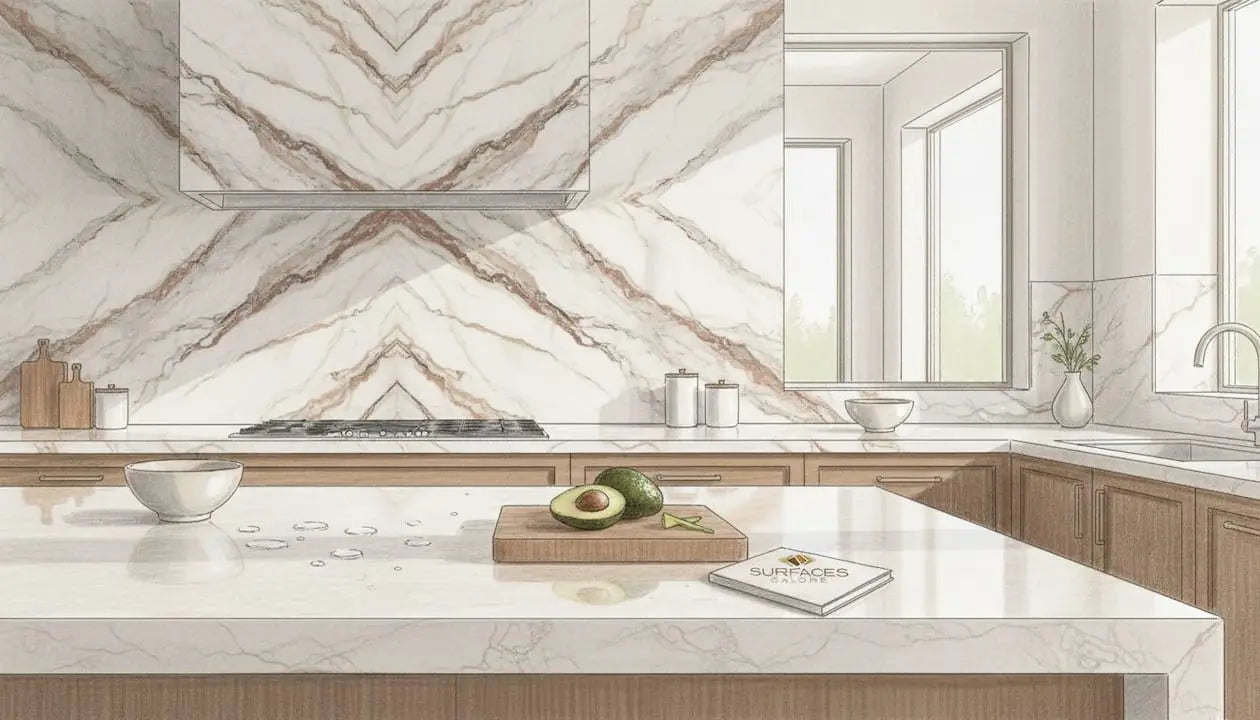
Bookmatched marble is a fabrication technique where two or more sequential slabs cut from the same stone block are placed side by side, with one flipped 180 degrees like opening a book, to create a continuous mirror-image veining pattern across the seam. Think of it like opening a hardcover book and looking at both pages at once. The left page mirrors the right. The veins don’t just continue across the seam, they reflect each other in a way that feels intentional and artful.
Standard marble installations use slabs that may come from the same quarry but not necessarily from the same block, or the same block but in non-sequential order. The veining has no relationship between slabs. It’s still beautiful, but it doesn’t tell the same visual story.
Here’s what makes bookmatching unique from a design standpoint:
- Symmetrical veining that flows across seams rather than stopping and restarting
- A gallery-quality focal point on walls, countertops, and shower surrounds
- A sense of intentional design that elevates the perceived value of any space
- Continuity of color and movement across large surfaces
“The most dramatic bookmatched installations treat the stone as a canvas. Each slab reveals its natural character, and the mirrored effect amplifies that character into something that looks hand-crafted.”
The effect is most striking on high-visibility surfaces. A full-height kitchen backsplash behind a range, a floor-to-ceiling bathroom wall, or a wide shower enclosure are all places where the bookmatched pattern commands immediate attention. On smaller surfaces, like a simple vanity top, the impact can be harder to appreciate fully. Knowing this matters when you’re deciding where to invest.
For a closer look at how slab selection affects visual results, the matching marble slabs guide covers the key differences in slab types and how they pair together across your design.
How is bookmatched marble created?
Understanding its definition sets the stage for exploring how these stunning, symmetrical surfaces are actually made. The fabrication process is more precise and involved than a standard marble installation, and that’s a key reason the cost premium exists.
Here’s a step-by-step look at how bookmatched marble goes from quarry to your wall:
-
Slab selection at the quarry or warehouse. The fabricator or stone supplier identifies a block with bold, consistent veining. Not every marble block is suitable. Fine or irregular veining will not produce a noticeable bookmatched effect. Blocks with dramatic diagonal veining, like Calacatta or Statuario, are ideal candidates.
-
Sequential cutting. The block is cut into sequential slabs, each given a number in the order it was cut. Slab 1 and Slab 2, for example, are bookmatching partners. This numbering is critical. Using Slab 1 and Slab 5 from the same block will not produce the same mirror effect because the veining pattern shifts too much between cuts.
-
Digital layout and preview. This step is where modern technology has transformed the process. High-resolution digital photos of each slab are placed side by side on a screen to preview the exact finished pattern before any cutting begins. This preview helps spot problems: veining that won’t align, color shifts between slabs, or areas with flaws or natural pits.
-
Precise cutting and fabrication. Once the layout is approved, the slabs are cut to exact dimensions. The seam edge receives special attention because both slabs must align perfectly when placed together. Even a small inconsistency at the seam will disrupt the mirror-image effect.
-
Expert installation. The slabs are set in the exact orientation determined during the digital preview phase. Seams are filled with tinted epoxy matched to the stone’s vein color to create the most seamless appearance possible.
Bookmatching requires slabs from the exact same block with sequential numbering. Misaligned seams, poor planning, or non-compatible veining can ruin the effect and waste premium slabs. Seams for bookmatched marble must be tighter than standard, often as close as 1/32 of an inch. This is not a DIY-friendly project.
Pro Tip: Always ask to see a digital layout preview before approving your bookmatched marble project. Any reputable fabricator or installer will have this capability, and it protects you from expensive surprises once the stone is set.
Bookmatched vs. standard marble workflow comparison
| Step | Standard marble | Bookmatched marble |
|---|---|---|
| Slab sourcing | Any compatible slab | Sequential slabs, same block |
| Digital layout preview | Optional | Essential |
| Seam tolerance | Up to 1/8 inch | 1/32 inch or tighter |
| Fabrication complexity | Moderate | High |
| Installation expertise required | General tile/stone | Specialty fabricator |
| Cost vs. standard | Baseline | 20 to 40% higher |
Understanding this workflow helps explain why bookmatched marble is almost exclusively handled by specialized stone contractors. A detailed look at the full process is available in the marble countertop installation guide and the marble shower installation workflow guide, both of which walk through installation sequences for different applications.
Costs and value: should you invest in bookmatched marble?
Once you understand the craftsmanship involved, it’s time to consider what this elegance means for your budget and project scope. The price premium for bookmatched marble is real, but so is the return when it’s applied in the right context.
Let’s break down the major cost components:
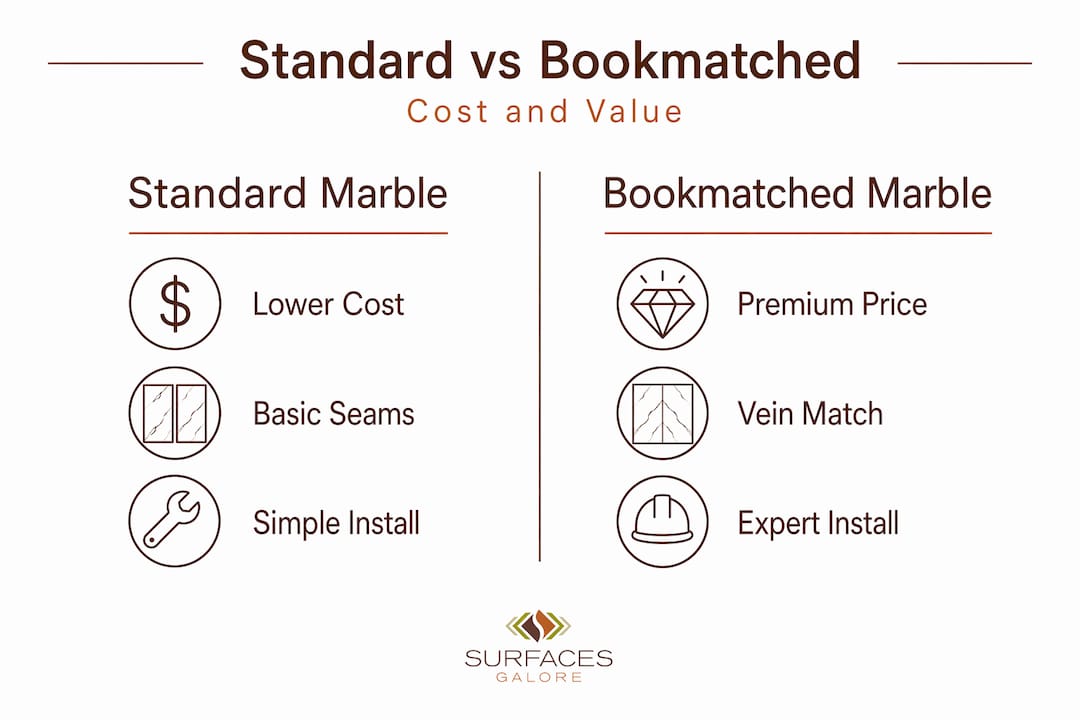
Material costs. The slabs themselves are more expensive for two reasons. First, you’re purchasing specific sequential slabs, which limits availability and may require buying from a premium inventory. Second, the lower slab yield means you pay for more stone than you actually install. Bookmatching adds 20 to 40% to fabrication costs over standard marble work, and slab yield for bookmatched projects typically runs between 55 and 70% compared to 80% or more for standard installations.
Fabrication costs. The tighter seam tolerances and digital layout requirements add to the fabricator’s time and labor. Expect to pay $200 to $500 extra per bookmatched seam compared to a standard seam.
Installed cost totals. A premium bookmatched marble like Calacatta typically runs $150 to $250 per square foot installed. Carrara marble in a standard installation, by contrast, runs $75 to $120 per square foot installed. That’s a meaningful difference in a large kitchen or master bathroom.
Bookmatched marble cost summary
| Marble type | Standard installed cost | Bookmatched installed cost |
|---|---|---|
| Carrara | $75 to $120/sq ft | $100 to $160/sq ft |
| Calacatta | $110 to $180/sq ft | $150 to $250/sq ft |
| Statuario | $130 to $200/sq ft | $175 to $280/sq ft |
These figures are useful benchmarks, but regional labor rates and specific project complexity will shift them. Always get itemized quotes.
Where does bookmatching genuinely earn its premium? Consider these situations:
- A statement fireplace surround where the mirrored veining becomes the room’s centerpiece
- A primary bathroom shower wall where large-format slabs create a spa-like atmosphere
- A kitchen island with a waterfall edge where the bookmatched pattern wraps from the countertop down the sides
- A formal entryway with a full bookmatched floor or wall feature
In contrast, bookmatching adds cost without adding much visible impact in situations like:
- Small powder rooms with limited wall space
- Utility areas where the stone is functional rather than decorative
- Projects using marble with subtle or low-contrast veining
Explore marble slab selection options to understand which stone varieties have the bold veining that truly justifies the bookmatched premium, and use choosing marble colors as a reference for matching stone color to your room’s palette before committing to a specific variety.
Long-term value. From a real estate perspective, a well-executed bookmatched marble feature in a kitchen or primary bathroom can become a major selling point. Buyers in mid-to-upper-tier markets often recognize bookmatched marble for what it is, and it signals quality craftsmanship throughout the property. Unlike trends that come and go, natural stone’s appeal is enduring.
Design applications: where bookmatched marble makes the biggest impact
Knowing what you’ll spend and what you’ll get, the next question is: Where does bookmatched marble genuinely deliver the wow factor? The answer comes down to surface size, visibility, and how the veining pattern interacts with the architecture of the space.
Full-height kitchen backsplashes. A continuous bookmatched slab running from the countertop to the ceiling cabinets, especially behind a range or cooktop, creates a dramatic focal point in any kitchen. The mirror-image veining draws the eye upward and makes the wall feel intentional rather than just functional. This is one of the most popular applications right now for a reason.
Shower walls and wet rooms. Large-format bookmatched slabs in a shower enclosure transform the bathroom from a utility space into something that feels like a high-end resort. The key here is using slabs that cover as much of the wall as possible without seams interrupting the pattern in awkward places. Positioning the seam along the natural vein flow creates continuity, while using tinted epoxy that matches the veining color makes seams nearly invisible. Digital or 3D layout planning is especially important in wet rooms where the tile pattern needs to work around fixtures, niches, and door frames.
Fireplace surrounds. A bookmatched marble fireplace surround is one of the most classic luxury design moves. The symmetry naturally frames the firebox and creates visual balance on either side of the hearth. Because the surface area is usually modest, this is also a relatively cost-effective way to introduce the bookmatched effect into a living room or study.
Feature and accent walls. Statement walls in dining rooms, entryways, or behind a headboard in a master bedroom are ideal for bookmatched marble panels. These walls typically don’t need to be functional, so the installation can prioritize aesthetics entirely.
Pro Tip: For waterfall countertop edges, 3D digital modeling is worth every penny. The veining must wrap seamlessly from the horizontal countertop surface down the vertical edge, and getting that transition wrong is both visually jarring and expensive to fix.
Here are a few additional design considerations that experienced installers prioritize:
- Seam placement matters enormously. Place seams where they’re least visible or where the natural vein line guides the eye past the join.
- Lighting amplifies the effect. Directional lighting that skims across the surface at an angle brings out the depth of the veining and makes the mirror pattern more dramatic.
- Contrasting grout or epoxy can unintentionally highlight seams. Always color-match your epoxy or grout to the dominant vein tone in your marble.
- Larger slabs reduce seam count. Fewer seams mean fewer disruptions to the pattern.
For broader installation considerations, the marble floor installation tips article covers substrate preparation and sealing practices that apply equally to wall and floor applications. And if you’re working with tile-format bookmatched pieces rather than full slabs, marble tile matching explained provides detailed guidance on how to orient and sequence tiles to maintain visual continuity across large areas.
The truth most designers won’t tell you about bookmatched marble
With these practical design ideas in mind, let’s cut through the hype and talk bluntly about when bookmatching is truly the best choice and when it simply isn’t.
The stone industry has done an excellent job promoting bookmatched marble as the gold standard of luxury. And it can be. But we’ve seen many projects where the bookmatching premium was spent on a stone that simply doesn’t benefit from it. Here’s the uncomfortable truth: bookmatching elevates natural stone to art when the stone itself has dramatic, expressive veining, but it adds cost without adding visual impact for subtle stones where standard slabs would work just as well.
If you’re choosing a marble with soft, diffuse veining because you want a quieter look, standard slab placement will serve you just as well at 30 to 40% less cost. Bookmatching is a tool for amplification. It takes what’s already bold and makes it bolder. It cannot manufacture drama where the stone itself doesn’t have it.
There’s also a planning reality that most designers gloss over because they’d rather talk about the beautiful outcomes. Bookmatching requires extremely precise supplier coordination. The sequential slabs need to be reserved together, stored correctly, and transported without damage. If one slab is chipped, cracked, or damaged before installation, replacing it with a matching slab from the same sequential set is often impossible. You may end up with a pattern that can’t be completed as designed.
This is why slab selection and supplier reliability are more important in a bookmatched project than in almost any other stone application. Working with a supplier who understands sequential slab management, stores inventory properly, and can give you accurate information about block availability is not optional. It’s the difference between a project that goes smoothly and one that gets derailed at the fabrication stage.
So when do we recommend bookmatching without reservation? When you have a large, high-visibility surface in a primary room. When you’re using a marble with strong, diagonal veining that genuinely benefits from the symmetry. When the budget allows for the full fabrication and installation process without shortcuts. And when you’ve done the digital layout work upfront so there are no surprises.
When should you save your money? When the surface is small or tucked away. When the marble has soft, low-contrast veining. When you’re working within a tight budget and every dollar needs to show up visually. In those cases, a well-chosen standard slab with careful orientation using how to match tile patterns techniques can give you a polished, cohesive look at a fraction of the cost.
The bottom line: bookmatched marble is genuinely extraordinary when the conditions are right. Our advice is to be honest about whether your project meets those conditions before committing to the premium.
Ready to explore bookmatched marble for your space?
If you’re inspired to bring bookmatched marble into your home, partnering with the right supplier makes all the difference. Sourcing sequential slabs from a knowledgeable direct importer who understands block availability and vein matching is the first step toward a project that actually delivers on the vision.
At Surfaces Galore, we specialize in premium natural stone imported directly from the world’s finest quarries, including marble varieties with the bold, dramatic veining that makes bookmatching truly spectacular. Our team understands the specific requirements of bookmatched projects, from slab reservation to digital layout support, and we ship nationwide to homeowners, designers, architects, and contractors. Browse our natural stone collection at surfacesgalore.com to explore available marble varieties, request samples, and connect with our stone specialists for personalized guidance on your renovation.
Frequently asked questions
What makes bookmatched marble so expensive compared to standard slabs?
Bookmatched marble slabs must be cut sequentially from the same block, require expert installation, and have a lower material yield of 55 to 70% compared to 80% or more for standard installations, all of which greatly increase overall costs. Fabrication premiums of 20 to 40% and seam costs of $200 to $500 per join add further to the total.
Can any type of marble be bookmatched for projects?
Not all marbles are visually suitable; bookmatching works best with bold veining, and slabs must come from the exact same block with sequential numbering. Marble with subtle or inconsistent veining will not produce a meaningful mirror-image effect.
Is bookmatched marble installation a DIY-friendly project?
No, it requires experienced professionals for planning, vein alignment, and ultra-tight seams of 1/32 inch to achieve the seamless, dramatic effect that makes bookmatching worthwhile. A DIY attempt risks misaligned patterns and wasted premium stone.
What rooms benefit most from bookmatched marble installations?
Bookmatched marble creates the strongest impact in kitchens, primary bathrooms, and statement fireplaces where continuous, symmetrical veining on high-visibility surfaces can be fully appreciated. Small or low-traffic areas rarely justify the premium.

Leave a comment